segunda-feira, 28 de fevereiro de 2022

Cryptowisser: Top 100 Crypto Coins Ranked by Carbon Footprint - Algorand Leads the Way – Press release Bitcoin News

PRESS RELEASE. February 2022: Leading Crypto service comparison site Cryptowisser, announces its Crypto Carbon Footprint list. The list ranks how sustainable the top 100 cryptocurrencies are and is based on the research of a Swedish team of sustainability experts.

The list ranks each coin of how a typical transaction affects the environment through its carbon footprint. The list uses a color scheme to display different levels of energy efficiency and carbon footprint, with dark green being the cleanest by carbon neutral or negative, and medium green being equivalent to a VISA transaction.

“We are excited to release the world’s first comprehensive ranking of carbon footprints of Cryptos and we hope to give more clarity in the market regarding how green different cryptos are. Based on our research, we can also give a positive outlook for the sustainability of Crypto”

Richard Ramberg, CEO of Dgtl Assets Group AB

How Does Crypto Have a Carbon Footprint?

The carbon footprint of cryptocurrency is based on the energy consumption from the daily operations, for example the process of mining or running of nodes in combination with how clean the energy is. Miners powered by renewables or based in a clean electricity grid will have a significantly lower carbon footprint than if powered by fossil fuels.

How many Cryptocurrencies are carbon neutral or negative?

According to the list, 12 of the cryptocurrencies are self-defined as carbon neutral or negative with Algorand taking the top spot as the greenest cryptocurrency on the market.

The vast majority of the coins have been ranked in the Light Green category, which means that most of the top 100 cryptocurrencies do have a relatively low carbon footprint.

From the data found, there are only a minority of coins that have a high carbon footprint, a positive outlook for the sustainable future of crypto, further reinforced by the current trend of even greener cryptos.

Proof of Stake or Proof of Work?

The energy consumption of the Cryptos depends primarily on the mechanism/consensus algorithm used for a block of transactions to be added to a Cryptocurrency’s digital ledger, so called blockchain, in combination with the energy efficiency of the equipment that is performing the algorithms.

The most common types are either Proof of Work (PoW) or Proof of Stake (PoS), while they have similarities, they differ in how they execute a transaction, where typically a Proof of Work transaction consumes about 1000 times the energy compared to a Proof of Stake transaction. As shown in the list, the coins associated with Proof of Stake occupy the top of the list being more carbon friendly, while most Proof of Work coins are less carbon friendly, but exceptions do exist.

Concluding Remarks

A carbon neutral or negative crypto world does not seem unachievable at all, even if the process of third party verification and “Proof of Green” need to accelerate. Most cryptocurrency transactions are similar to a VISA transaction in terms of carbon emissions; however, the two top cryptocurrencies (BTC and ETH) do have work to do to become more energy efficient and sustainable.

For more information, please contact press@cryptowisser.com

Cryptowisser is a cryptocurrency services comparison site with the world’s largest, most frequently updated and most trusted lists of cryptocurrency exchanges, wallets, debit cards and merchants with more than 1000 reviews. We help you make all your purchasing decisions and service choices in the crypto world.


This is a press release. Readers should do their own due diligence before taking any actions related to the promoted company or any of its affiliates or services. Bitcoin.com is not responsible, directly or indirectly, for any damage or loss caused or alleged to be caused by or in connection with the use of or reliance on any content, goods or services mentioned in the press release.

Bitcoin.com is the premier source for everything crypto-related. Contact ads@bitcoin.com to talk about press releases, sponsored posts, podcasts and other options.

Image Credits: Shutterstock, Pixabay, Wiki Commons

Farmville Creator Zynga to Launch NFT Games, Says Gaming Firm's Blockchain Lead

American social game developer Zynga has plans to launch non-fungible token (NFT) games in the near future. Zynga’s vice president of blockchain, ​​Matt Wolf, told the press that the company is looking at the cycle right now and “figuring out ... read more.

Elon Musk Hears Kyiv’s Call, Activates Starlink Service in Ukraine – Bitcoin News

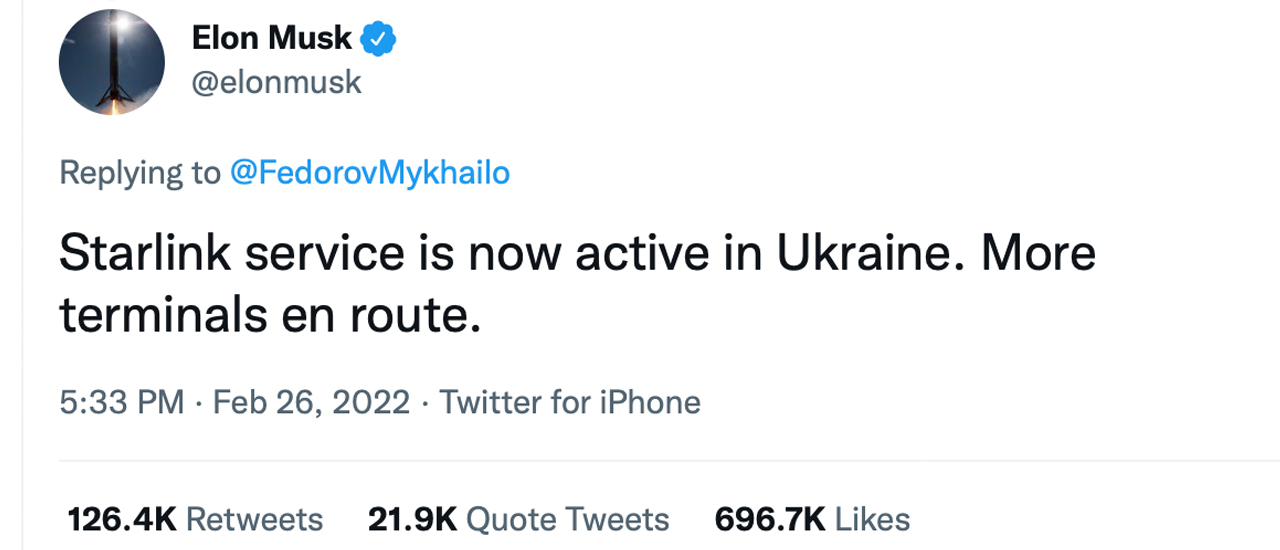
Tech entrepreneur Elon Musk has announced that the Starlink satellite internet service has been enabled for Ukraine. The move comes in response to a request from the government in Kyiv which is trying to halt a Russian military assault that may disrupt communications, among other threats.

U.S. billionaire and crypto influencer Elon Musk revealed on social media the activation of Starlink for Ukraine. The satellite internet constellation is operated by Spacex, the aerospace manufacturer and provider of space transportation services founded and managed by Musk.

The entrepreneur also tweeted that the company is sending Ukrainians the necessary equipment. Starlink’s low-orbit satellites provide high-speed broadband internet across the globe but access to the network requires the installation of a special antenna and modem.

Earlier on Saturday, Ukraine’s Minister of Digital Transformation Mykhailo Fedorov took to Twitter to address Musk directly:

Elon Musk Hears Kyiv’s Call, Activates Starlink Service in Ukraine

Following President Putin’s order, Russia launched a military assault on Ukraine on Feb. 24. Since then, Russian forces have been advancing, encircling major Ukrainian cities. Authorities, citizens and members of the crypto community fear the country’s communications with the world may be affected.Internet monitor Netblocks has registered “a series of significant disruptions to internet service” since the beginning of the Russian military operations in the country, AFP reported. While Starlink operates more than 2,000 satellites, it was initially unclear if Ukrainians would be able to use the service.

“Starlink terminals are coming to Ukraine! Thank you @elonmusk, thank you everyone, who supported Ukraine!” Fedorov tweeted following Musk’s reaction. The government official also expressed his gratitude to Ukrainian Ambassador to the U.S. Oksana Markarova for the “swift decisions related to authorization and certification that allowed us to activate the Starlink.”

Ukraine, which was on the verge of regulating digital assets when the Russian military offensive started, has also sought assistance for its defense effort in the form of crypto donations. One of the largest NGOs involved in supporting the country’s military, Come Back Alive, has already received millions of dollars in bitcoin.

Do you think Elon Musk’s help will allow Ukraine to maintain internet communications with the world? Share your thoughts on the subject in the comments section below.

Lubomir Tassev is a journalist from tech-savvy Eastern Europe who likes Hitchens’s quote: “Being a writer is what I am, rather than what I do.” Besides crypto, blockchain and fintech, international politics and economics are two other sources of inspiration.

Image Credits: Shutterstock, Pixabay, Wiki Commons

Disclaimer: This article is for informational purposes only. It is not a direct offer or solicitation of an offer to buy or sell, or a recommendation or endorsement of any products, services, or companies. Bitcoin.com does not provide investment, tax, legal, or accounting advice. Neither the company nor the author is responsible, directly or indirectly, for any damage or loss caused or alleged to be caused by or in connection with the use of or reliance on any content, goods or services mentioned in this article.

India Won't Legalize or Ban Crypto at This Stage, Finance Minister Confirms

India's finance minister has revealed the current status of crypto policy in India, including whether crypto will be legalized or banned in the country. The question surrounding the legitimacy of cryptocurrency was raised in parliament after the government announced that ... read more.

Value Locked in Defi Rebounds — Smart Contract Tokens CPH, LUNA, XCP Lead the Pack – Defi Bitcoin News

The total value locked in decentralized finance (defi) has managed to jump above the $200 billion zone, as crypto markets have rebounded from the market downturn last week. A number of native assets from the $611 billion worth of smart contract protocols have seen double-digit gains with cypherium (CPH), counterparty (XCP), and terra (LUNA) leading the pack.

Crypto markets have recovered after initially dropping after Russia invaded Ukraine three days ago and the rebound has pushed defi value up as well. After falling beneath the $200 billion mark, the total value locked (TVL) in defi has jumped back above the zone to $200.94 billion on February 27.

The TVL in defi across all the top blockchains hit a low of $185.9 billion on January 28 and it’s up 10.61% since that day. Curve dominance is 8.68% on Sunday with $17.86 billion total value locked but the defi protocol’s TVL is down 5.61% since last week.

Ethereum dominance, in terms of the TVL in defi today, is 55.94% with the current $112.36 billion TVL. Terra’s the second-largest blockchain TVL in defi on Sunday with $20.17 billion which is 10.04% of the TVL in defi.

The third-largest blockchain TVL in defi is Binance Smart Chain (BSC) with $12.13 billion locked. Defillama.com metrics show Chainlink is the largest defi oracle today securing 138 protocols with $52.66 billion locked.

In terms of smart contract coins, cypherium (CPH) was this week’s biggest gainer with a 330% gain. The smart contract coin, in terms of this week’s second-largest gains, is the old-school token counterparty (XCP). Counterparty has jumped 54% higher in value against the U.S. dollar during the last seven days.

Terra (LUNA) managed to spike by 52% this past week as the coin is the third-largest smart contract token gainer this week. At the time of writing, the aggregate value of all the smart contract platform native tokens in existence is $611 billion down 0.3% in the last day.

Presently, there’s $23.63 billion TVL across cross-chain bridge platforms today up 16.6% since last week. The count of unique bridge deposit addresses during the last month is 57,911 addresses.

The top five blockchains in terms of cross-chain bridge TVL on Sunday, February 27 include Avalanche, Polygon, Fantom, Ronin, and Arbitrum. Moreover, data collected by Coin98 Analytics from Santiment indicates that Solana has the most active developer count as of February 19, 2022. Solana’s developer count is followed by Ethereum, Cardano, Polkadot, Cosmos, and Terra.

What do you think about this week’s decentralized finance action? Let us know what you think about this subject in the comments section below.

Jamie Redman is the News Lead at Bitcoin.com News and a financial tech journalist living in Florida. Redman has been an active member of the cryptocurrency community since 2011. He has a passion for Bitcoin, open-source code, and decentralized applications. Since September 2015, Redman has written more than 5,000 articles for Bitcoin.com News about the disruptive protocols emerging today.

Image Credits: Shutterstock, Pixabay, Wiki Commons, Coin98 Analytics, Defillama.com, Santiment,

Disclaimer: This article is for informational purposes only. It is not a direct offer or solicitation of an offer to buy or sell, or a recommendation or endorsement of any products, services, or companies. Bitcoin.com does not provide investment, tax, legal, or accounting advice. Neither the company nor the author is responsible, directly or indirectly, for any damage or loss caused or alleged to be caused by or in connection with the use of or reliance on any content, goods or services mentioned in this article.

Farmville Creator Zynga to Launch NFT Games, Says Gaming Firm's Blockchain Lead

American social game developer Zynga has plans to launch non-fungible token (NFT) games in the near future. Zynga’s vice president of blockchain, ​​Matt Wolf, told the press that the company is looking at the cycle right now and “figuring out ... read more.
Ethereum Network Fees Continue to Drop — Transfer Fees Hit Lowest Rate in 6 Months – Altcoins Bitcoin News

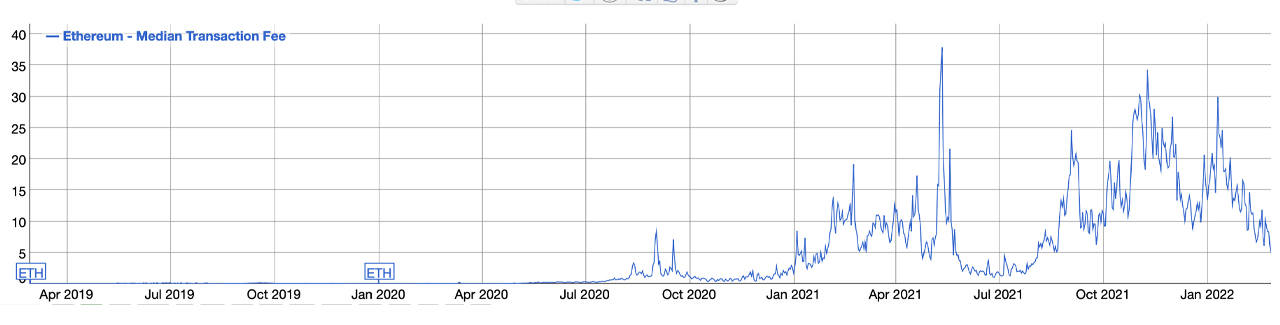
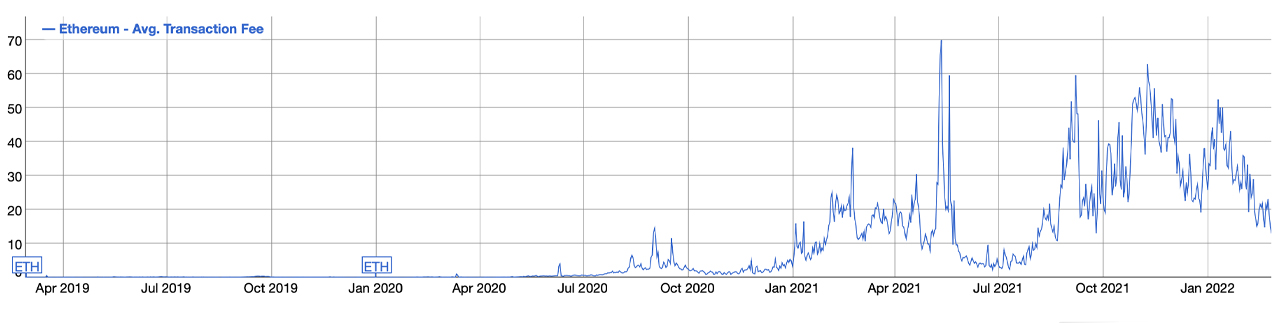
It’s getting cheaper to send ethereum these days as the gas price to push a transaction is more than 80% less expensive than it was to transact with ether 48 days ago on January 10. On that day, Ethereum network fees were around $52 per transaction and today, the average transaction fee is $10.26 per transfer. While on-chain fees are cheaper, layer two (L2) transactions have followed suit dropping significantly during the last seven days.

It’s a lot less expensive to transact with the Ethereum (ETH) network on February 27, as average size fees are down to 0.0039 ETH or $10.26 per transfer. The last time Ethereum network fees were this low was six months ago, back in late-August 2021.

Currently, with average fees at $10.26 per transfer, it’s 80.26% cheaper than it was transferring ETH on January 10, 2022. At that time over a month ago, the average transaction fee was $52 per transaction.

Ethereum Network Fees Continues to Drop — Transfer Fees Hit Lowest Rate in 6 Months

Ethereum fees have been sliding downward ever since that day and median-sized gas fees have followed. While the median-sized gas fee was $29 in ether 48 days ago on January 10, today it’s down 84.31% lower at 0.0017 ETH or $4.55 per transfer.

Ethereum Network Fees Continues to Drop — Transfer Fees Hit Lowest Rate in 6 Months

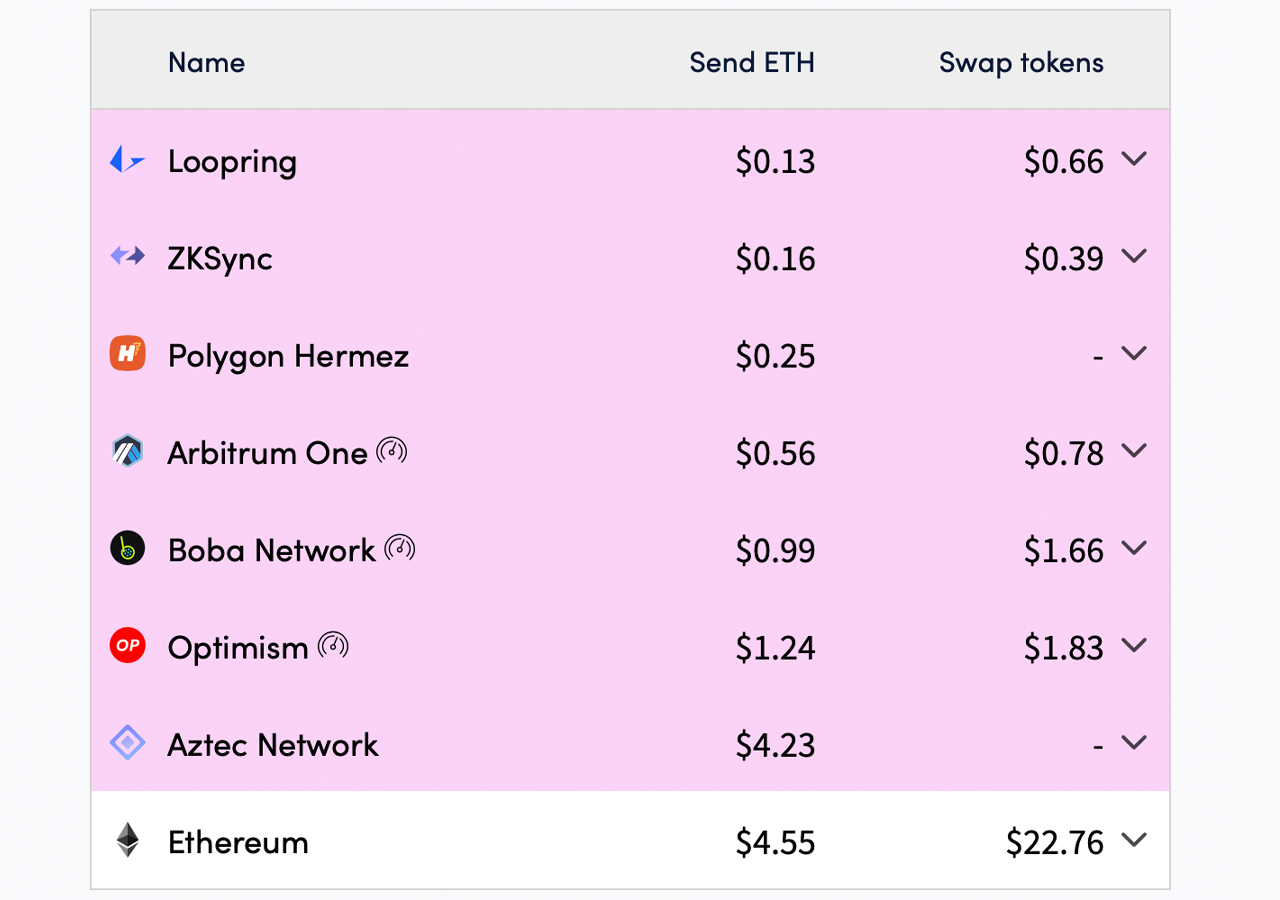
L2 transactions are also cheaper than on-chain transactions since gas fees have plummeted. Currently, the lowest L2 fee to send ethereum is by leveraging Loopring for $0.13 per transfer. To swap tokens with Loopring, the gas fees will cost $0.66 per swap at the time of writing.

Loopring is followed by Zksync ($0.16), Polygon Hermez ($0.25), Arbitrum ($0.56), Boba Network ($0.99), Optimism ($1.24), and Aztec ($4.23) in order to push an ethereum (ETH) transaction via L2.

Ethereum Network Fees Continues to Drop — Transfer Fees Hit Lowest Rate in 6 Months

The cost to swap tokens through these L2 platforms is $0.39 using Zksync, $0.78 leveraging Arbitrum, $1.66 via Boba, and $1.83 Optimism.

On-chain fees on the Bitcoin (BTC) network are also lower at 0.000000086 BTC per byte on February 27, 2022, which equates to 0.000032 BTC or $1.20 per transaction. Moreover, the median-sized bitcoin fee on Sunday is roughly 0.0000078 BTC or $0.29 per transaction.

What do you think about average transaction fees on the Ethereum network dropping? Let us know what you think about this subject in the comments section below.

Jamie Redman is the News Lead at Bitcoin.com News and a financial tech journalist living in Florida. Redman has been an active member of the cryptocurrency community since 2011. He has a passion for Bitcoin, open-source code, and decentralized applications. Since September 2015, Redman has written more than 5,000 articles for Bitcoin.com News about the disruptive protocols emerging today.

Image Credits: Shutterstock, Pixabay, Wiki Commons

Disclaimer: This article is for informational purposes only. It is not a direct offer or solicitation of an offer to buy or sell, or a recommendation or endorsement of any products, services, or companies. Bitcoin.com does not provide investment, tax, legal, or accounting advice. Neither the company nor the author is responsible, directly or indirectly, for any damage or loss caused or alleged to be caused by or in connection with the use of or reliance on any content, goods or services mentioned in this article.

Students Mining Crypto in Dorms May Face Criminal Prosecution in Russia, Lawyer Says

University students in Russia minting digital currencies in their dormitories risk penalties and even criminal charges, according to a legal expert quoted by local media. The warning comes as Russian authorities are trying to curb crypto mining with cheap energy ... read more.

Japanese Online Retail Giant Rakuten Launches NFT Marketplace – Bitcoin News

Rakuten Group, the Japanese electronic commerce and online retail company based in Tokyo has announced the launch of a non-fungible token (NFT) marketplace called Rakuten NFT. The announcement notes that new features will be added in the future, and a peer-to-peer service for minting and selling NFT content is planned to launch in 2023.

During the last few years, the Japanese online retail giant Rakuten has been dipping its feet into the world of cryptocurrencies and blockchain solutions. In the summer of 2019, Rakuten launched a cryptocurrency exchange and in the spring of 2021, Rakuten allowed customers to load crypto into Rakuten Pay accounts. Now the company is getting into the NFT game, as Rakuten announced the launch of a new platform called Rakuten NFT.

“Rakuten NFT is a service that provides a marketplace for users to purchase NFTs, as well as peer-to-peer buying and selling of NFTs, in a range of areas such as sports and entertainment, including music and anime,” the press announcement explains. “It also features a unique, one-stop platform which enables IP holders to build their own website for issuing and selling NFTs. Rakuten ID can be used when making purchases, allowing users to earn and spend Rakuten Points. Any NFTs purchased can be added to a collection on the buyer’s own webpage, and can also be put up for sale in the marketplace and sold.”

Rakuten follows a number of businesses that have launched NFT marketplaces during the last 12 months. Companies like Coinbase, FTX, Crypto.com, and many others have launched marketplace platforms dedicated to non-fungible token (NFT) collectibles. Additionally, Rakuten NFT faces competition from leading NFT market platforms such as Opensea, Rarible, Looksrare, and Magic Eden. Rakuten’s press announcement notes that a minting and selling feature won’t be available until next year.

“A service for peer-to-peer issuing and selling of NFT content is planned for launch in 2023 or later, which will support IP holders in Japan and worldwide to issue NFTs, as well as spur further development of a global market for NFTs. Plans also call for the introduction of a diversity of additional payment methods,” Rakuten’s launch announcement discloses.

The Rakuten NFT launch featured NFTs showcasing Ultraman anime and Kurogane Hiroshi G1 Gekitoshi with work illustrated by the renowned manga artist Hiroshi Kurogane. In future NFT drops, Rakuten NFT will feature collectibles from TV Asahi Corporation shows, Under Beasty from Daiki Sound Co., and NFTs featuring characters from Tiger & Bunny 2.

“Rakuten NFT is also planning to produce and sell the J.League NFT Collection Players Anthem, the J.League official NFT collection,” the company’s NFT platform announcement concludes.

What do you think about Rakuten launching an NFT marketplace? Let us know what you think about this subject in the comments section below.

Jamie Redman is the News Lead at Bitcoin.com News and a financial tech journalist living in Florida. Redman has been an active member of the cryptocurrency community since 2011. He has a passion for Bitcoin, open-source code, and decentralized applications. Since September 2015, Redman has written more than 5,000 articles for Bitcoin.com News about the disruptive protocols emerging today.

Image Credits: Shutterstock, Pixabay, Wiki Commons

Disclaimer: This article is for informational purposes only. It is not a direct offer or solicitation of an offer to buy or sell, or a recommendation or endorsement of any products, services, or companies. Bitcoin.com does not provide investment, tax, legal, or accounting advice. Neither the company nor the author is responsible, directly or indirectly, for any damage or loss caused or alleged to be caused by or in connection with the use of or reliance on any content, goods or services mentioned in this article.

PUBG Developer Parent Company Krafton to Work On NFT and Metaverse Related Projects

Krafton, the parent company of Bluehole, developers of PUBG, a popular battle royale game that has earned more than $300 million in 2021, announced it will redirect some of its activities toward developing NFT and metaverse-related projects. The company says ... read more.

Ukraine Targets Russian Politicians’ Crypto Wallets as Russian Banks Are Cut From SWIFT – Bitcoin News

Ukraine is now trying to expose cryptocurrency wallets used by politicians in Moscow amid warnings that Russia may employ digital coins to circumvent sanctions. The initiative comes as western allies agree to expel some Russian banks from SWIFT, the global interbank payments system.

Authorities in Kyiv have issued a call on social media for information about crypto wallets controlled by politicians in Russia and Belarus. On Saturday, Ukraine’s Deputy Prime Minister Mykhailo Fedorov announced on Twitter that the country’s crypto community will reward those who provide details leading to their identification.

Ukrainian crypto community is ready to provide a generous reward for any information about crypto-wallets of Russian and Belarusian politicians and their surroundings. War crimes must be pursued and punished! To share info please contact in Telegram: https://t.co/XHidwUQ8bE.

— Mykhailo Fedorov (@FedorovMykhailo) February 26, 2022

The rewards will be funded by private donations, according to Artem Afian, a lawyer managing the effort. Quoted by Bloomberg, he said the campaign has already received tips matching political figures with crypto addresses. The plan is to share them with major exchanges and the blockchain forensics firm Chainalysis which has been monitoring Russian transactions. Afian stated:

We want them to understand that they are not welcome in Ukraine or in crypto.

Another report has revealed that several trading platforms have imposed restrictions for users based in the Russian Federation. The Ukrainian crypto exchange Kuna told Forklog it removed all pairs with the Russian ruble and stopped deposits and withdrawals. Whitebit rejects new registrations from Russia while Cex.io is not accepting or serving customers from Russia, Belarus, and Ukraine.

The government in Kyiv has been urging for stronger sanctions against Moscow in the face of advancing Russian forces. The initiative to blacklist wallets owned by Russian politicians comes as Ukraine itself resorts to using cryptocurrency to finance its defense effort. Since the start of the invasion, the country has raised more than $17 million in crypto donations.

Meanwhile, the United States, Canada, the United Kingdom, the European Commission and several EU member states – France, Germany, and Italy – announced their commitment to remove “selected Russian banks” from the SWIFT messaging network for interbank payments.

“This will ensure that these banks are disconnected from the international financial system and harm their ability to operate globally,” their leaders said in a joint statement released late on Saturday.

The tightening of western sanctions, directed at isolating Russia from global finances, has raised concerns among analysts that Moscow may turn to cryptocurrency in order to circumvent the mounting restrictions. Russian institutions have been actively working to regulate crypto transactions and the Ministry of Finance recently submitted a new bill to the federal government.

Do you think Ukraine will be able to identify crypto wallets used by Russian politicians? Tell us in the comments section below.

Lubomir Tassev is a journalist from tech-savvy Eastern Europe who likes Hitchens’s quote: “Being a writer is what I am, rather than what I do.” Besides crypto, blockchain and fintech, international politics and economics are two other sources of inspiration.

Image Credits: Shutterstock, Pixabay, Wiki Commons

Disclaimer: This article is for informational purposes only. It is not a direct offer or solicitation of an offer to buy or sell, or a recommendation or endorsement of any products, services, or companies. Bitcoin.com does not provide investment, tax, legal, or accounting advice. Neither the company nor the author is responsible, directly or indirectly, for any damage or loss caused or alleged to be caused by or in connection with the use of or reliance on any content, goods or services mentioned in this article.

PUBG Developer Parent Company Krafton to Work On NFT and Metaverse Related Projects

Krafton, the parent company of Bluehole, developers of PUBG, a popular battle royale game that has earned more than $300 million in 2021, announced it will redirect some of its activities toward developing NFT and metaverse-related projects. The company says ... read more.

Drilling at West Africa Abujar Gold Deposit Garners Over 503 Grams Per Tonne – Featured Bitcoin News

Ivory Coast or Côte d’Ivoire’s Tietto Minerals recently said it had drilled and extracted as much as 503.85 grams per tonne from 83 metres at its Abujar Gludehi deposit. The drilling result moves the miner another step towards production on what may become West Africa’s biggest new gold mines, a report has suggested.

Tietto Minerals, the Ivory Coast-based gold miner, has reportedly drilled 503.85 grams per tonne (g/t) from 83 metres at its flagship Abujar-Gludehi deposit. On top of this very high grade, the miner’s other better results include a 10-metre hit which had 51.75 g/t. An even richer 3-metre section had about 171 g/t from the same depth.

According to a report by The West, the Abujar-Gludehi deposit is, in fact, part of a larger Abujar gold project which is comprised of three “contiguous tenements” that have a total land area of 1,114 square kilometres. Similar to the Gludehi deposit, the report noted that the miner’s other prospects had delivered noteworthy hits “including a 1m section at 46.2 g/t gold from 141m and a 2m hit going 8.8 g/t gold from 151m.”

In gold prospecting terms, a high-grade gold deposit seemingly shows that there is more gold content for every tonne of gold ore. This grade in turn shows the profitability of the deposit. According to the gold exploration industry, a “bonanza result” is as any result above 34g/t- which is an extremely high grade. Anything above 5 g/t is considered high grade while anything above 34 g/t is considered to be another level, a report by Next Investors has said.

Meanwhile, as it waits for the results of 36 additional holes, Tietto Minerals, as suggested in the report, is hoping the pending results will add even more high-grade gold.

Caigen Wang, Tietto Minerals’ managing director is quoted in the report remarking the mining company’s prospects. He said:

Our drill rigs have moved to prospects located to the north [GGL] and south [AGM, PGL] of AG Core with the goal of defining new gold resources in an update late this year. The high‐grade gold intercepts seen in the latest results highlight the prospectivity and still largely untested potential of the main Abujar Shear.

Meanwhile, a different report suggested the highlight of the miners’ impressive drilling results was a 2.4m intercept grading 153.49 grams per tonne gold, with a 1.4m higher interval assaying at 262.59g/t. According to this report, the mineralisation was intersected 31.6m from the surface.

What are your thoughts on this story? Tell us what you think in the comments section below.

Terence Zimwara is a Zimbabwe award-winning journalist, author and writer. He has written extensively about the economic troubles of some African countries as well as how digital currencies can provide Africans with an escape route.

Image Credits: Shutterstock, Pixabay, Wiki Commons

Disclaimer: This article is for informational purposes only. It is not a direct offer or solicitation of an offer to buy or sell, or a recommendation or endorsement of any products, services, or companies. Bitcoin.com does not provide investment, tax, legal, or accounting advice. Neither the company nor the author is responsible, directly or indirectly, for any damage or loss caused or alleged to be caused by or in connection with the use of or reliance on any content, goods or services mentioned in this article.

PUBG Developer Parent Company Krafton to Work On NFT and Metaverse Related Projects

Krafton, the parent company of Bluehole, developers of PUBG, a popular battle royale game that has earned more than $300 million in 2021, announced it will redirect some of its activities toward developing NFT and metaverse-related projects. The company says ... read more.